
Strategy Matrix
The "strategy matrix" is an approach for developing the optimizing strategies to address multiple objectives. Objectives are shown on the left-hand side of the matrix, and strategies are shown on the top of the matrix. The squares in the matrix show how the strategies achieve the objectives. For example, the boxes in the matrix at the intersection of a strategy and an objective are marked as follows:
An "x" or a "+" is marked in boxes where the strategy is key to achieving the objective. A "o" or a "0" is marked in boxes where the strategy is of secondary importance in achieving the ojbective. A "-" is marked in boxes where a strategy actually makes it more difficult to achieve the objective. And finally, no mark is made in boxes where the strategy has no impact, or minimal impact on achieveing the objective.
This strategy matrix allows easy examination of alternative strategies to achieve the desired objectives. The goal is to define the simplest, most cost-effective, and the most practical strategies that will achieve all requirements. When this is achieved, the matrix will have a lot of "x" or "+" marks and many "o" and "0" marks, and hopefully no "-" marks. The following discussion illustrates how the strategy matrix was used to develop a set of strategies to address America's must urgent problems.
The strategy matrix is particularly useful when designing and optimizing a large, complex system that is a combination of many interrelated systems. The International Space Station is a good example. It comprises many systems and elements, designed by engineers in many countries (primarily the United States, Russia, Japan, Canada, and several European countries), which was launched on U.S. and Russian launch vehicles, assembled in-orbit over a period of several years, and operated in-orbit for over 25 years. Developing the Space Station required both technical and political skills to keep all nations working together over a period of over 30 years.
Public policies are similarly complex and interrelated. For example, public policies relalted to healthcare, immigration, criminal justice, and taxation all affect each other, so they cannot be optimized separately, but must be considered together. The following figure shows the strategy matrix I used to develop ten public policies to address America's most urgent problems. This figure is described in the text following the figure.
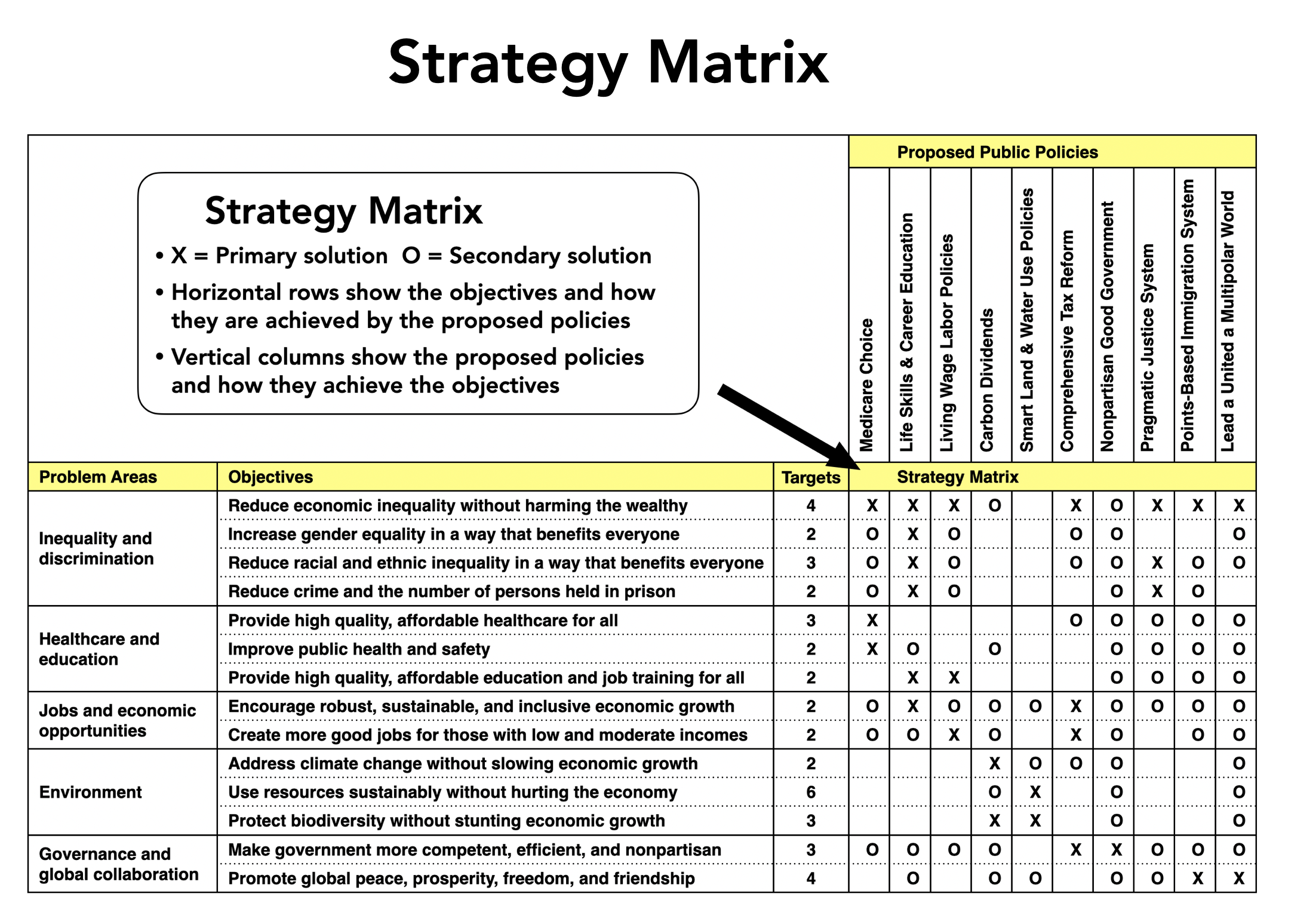
The first column on the left shows 5 problem areas and the second column shows 15 qualitative objectives designed to address urgent problems. The third column shows the number of quantitative objectives (targets) established for each objective. There are 40 quantitative "targets" in this example. I identified these 5 problem areas and developed these 15 objectives and the 40 quantitative targets using the United Nations' Sustainable Development Goals as the starting point.
The 10 columns on the right-hand side of this figure show the 10 policies (strategies) I developed to address the problem areas, objectives, and targets in the first three columns. This strategy matrix aided in developing these public policies, by showing how each policy addresses multiple objectives. For example, the first policy (Medicare Choice) is designed primarily to address three objectives: 1) reduce economic inequality without harming the wealthy, 2) provide high quality, affordable healthcare for everyone, and 3) improve public health and safety. This is shown on the figure by the X's in the strategy matrix. It is also designed to address six other objectives secondarily, as shown by the O's in the strategy matrix.
Similarly, the second proposed policy (Life Skills and Career Education) is designed to primarily address six objectives: 1) reduce economic inequality without harming the wealthy, 2) increase gender equality in a way that benefits everyone, 3) reduce racial and ethnic inequality in a way that benefits everyone, 4) reduce crime and the number of persons held in prison, 5) provide high quality, affordable education and job training for all, and 6) encourage robust, sustainable, and inclusive economic growth. In addition to these six primary objectives, this policy is designed to address four other objectives secondarily, as denoted by the O's in the strategy matrix.
Strategy matrices such as the this one do not provide simple answers to complex challenges, but they are an important tool that systems engineers use to optimize the design of complex "systems of systems." The "six-step process" and the "optimization strategies" are still needed to design and optimize individual public policies, but the "system of systems" strategy matrix allows policymakers to examine the interrelationships between multiple objectives and multiple public policies.
The "strategy matrix" is an approach for developing the optimizing strategies to address multiple objectives. Objectives are shown on the left-hand side of the matrix, and strategies are shown on the top of the matrix. The squares in the matrix show how the strategies achieve the objectives. For example, the boxes in the matrix at the intersection of a strategy and an objective are marked as follows:
An "x" or a "+" is marked in boxes where the strategy is key to achieving the objective. A "o" or a "0" is marked in boxes where the strategy is of secondary importance in achieving the ojbective. A "-" is marked in boxes where a strategy actually makes it more difficult to achieve the objective. And finally, no mark is made in boxes where the strategy has no impact, or minimal impact on achieveing the objective.
This strategy matrix allows easy examination of alternative strategies to achieve the desired objectives. The goal is to define the simplest, most cost-effective, and the most practical strategies that will achieve all requirements. When this is achieved, the matrix will have a lot of "x" or "+" marks and many "o" and "0" marks, and hopefully no "-" marks. The following discussion illustrates how the strategy matrix was used to develop a set of strategies to address America's must urgent problems.
The strategy matrix is particularly useful when designing and optimizing a large, complex system that is a combination of many interrelated systems. The International Space Station is a good example. It comprises many systems and elements, designed by engineers in many countries (primarily the United States, Russia, Japan, Canada, and several European countries), which was launched on U.S. and Russian launch vehicles, assembled in-orbit over a period of several years, and operated in-orbit for over 25 years. Developing the Space Station required both technical and political skills to keep all nations working together over a period of over 30 years.
Public policies are similarly complex and interrelated. For example, public policies relalted to healthcare, immigration, criminal justice, and taxation all affect each other, so they cannot be optimized separately, but must be considered together. The following figure shows the strategy matrix I used to develop ten public policies to address America's most urgent problems. This figure is described in the text following the figure.
The first column on the left shows 5 problem areas and the second column shows 15 qualitative objectives designed to address urgent problems. The third column shows the number of quantitative objectives (targets) established for each objective. There are 40 quantitative "targets" in this example. I identified these 5 problem areas and developed these 15 objectives and the 40 quantitative targets using the United Nations' Sustainable Development Goals as the starting point.
The 10 columns on the right-hand side of this figure show the 10 policies (strategies) I developed to address the problem areas, objectives, and targets in the first three columns. This strategy matrix aided in developing these public policies, by showing how each policy addresses multiple objectives. For example, the first policy (Medicare Choice) is designed primarily to address three objectives: 1) reduce economic inequality without harming the wealthy, 2) provide high quality, affordable healthcare for everyone, and 3) improve public health and safety. This is shown on the figure by the X's in the strategy matrix. It is also designed to address six other objectives secondarily, as shown by the O's in the strategy matrix.
Similarly, the second proposed policy (Life Skills and Career Education) is designed to primarily address six objectives: 1) reduce economic inequality without harming the wealthy, 2) increase gender equality in a way that benefits everyone, 3) reduce racial and ethnic inequality in a way that benefits everyone, 4) reduce crime and the number of persons held in prison, 5) provide high quality, affordable education and job training for all, and 6) encourage robust, sustainable, and inclusive economic growth. In addition to these six primary objectives, this policy is designed to address four other objectives secondarily, as denoted by the O's in the strategy matrix.
Strategy matrices such as the this one do not provide simple answers to complex challenges, but they are an important tool that systems engineers use to optimize the design of complex "systems of systems." The "six-step process" and the "optimization strategies" are still needed to design and optimize individual public policies, but the "system of systems" strategy matrix allows policymakers to examine the interrelationships between multiple objectives and multiple public policies.