
Tax Reform
I developed a comprehensive, nonparisan proposal to fundamentally reform the United States' federal tax system. The key to successful tax reform is to find a way to eliminate government waste so the savings can be used for worthwhile purposes, such as restoring Social Security and Medicare to financial health, balancing the federal budget, and funding universal health care. The two most wasteful government policies are 1) healthcare policies, which have created a costly, inefficient, and wasteful healthcare system, and 2) the tax code, which contains many wasteful and counterproductive tax expenditures. (Tax expenditures are tax exemptions, deductions, exclusions, credits, preferences, and deferrals that result in a loss of tax revenue. These tax expenditures are sometimes called tax loopholes.)
The proposed tax reform decreases waste in the tax code and healthcare systems by 1) eliminating most tax expenditures and replacing them with a significant tax credit for every taxpayer and dependent and 2) replacing the current healthcare system with a more efficient universal healthcare system, which I call "Medicare Choice." By making the tax and healthcare systems more efficient, the proposed tax reform provides sufficient revenue to balance the federal budget, restore Social Security and Medicare to financial health, maintain current and planned defense spending and other government services, and pay for “Medicare Choice” and universal healthcare--without increasing the burden on taxpayers. Making the tax code simpler and fairer will create new opportunities for sustainable economic growth.
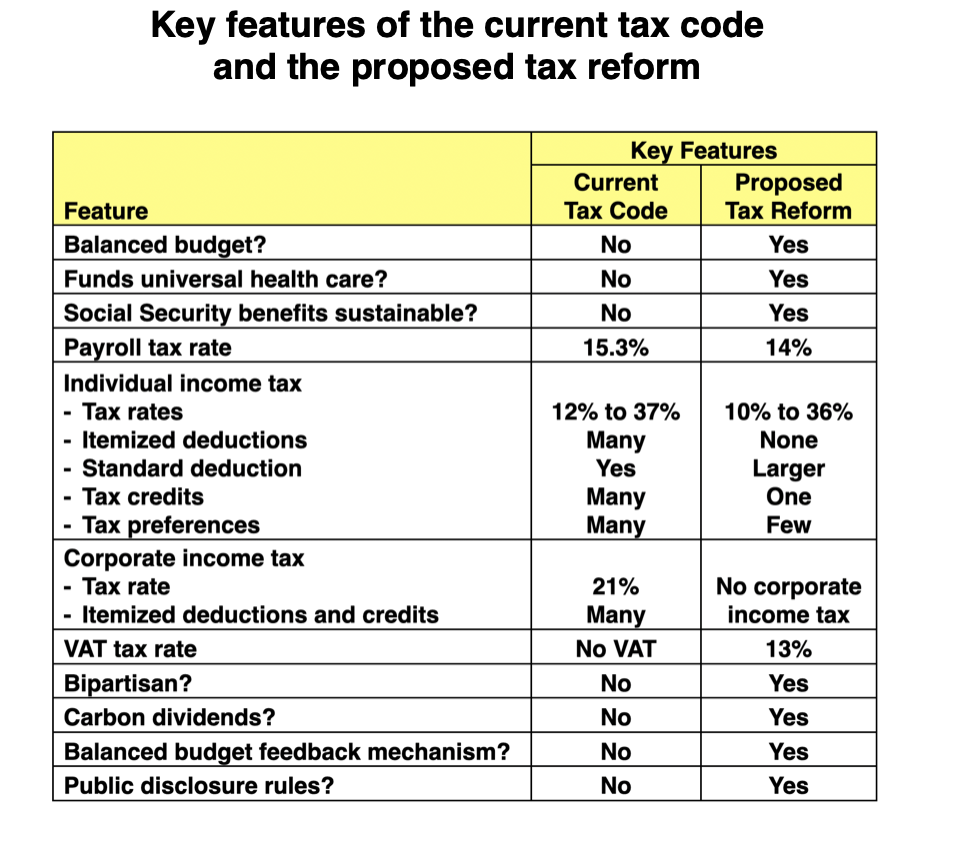
The key features of the current tax code and the proposed tax reform are summarized in the figure and discussed in the text following the figure.
 The key features of the proposed tax reform are as follows:
1. Balanced budget: The proposed tax reform balances the federal budget and funds universal healthcare without increasing the economic burden on taxpayers or decreasing other government services. It does this by (1) reforming the healthcare system and tax code to make them better and more efficient and (2) using the resulting cost savings to balance the budget.
2. Healthcare Reform: The proposed tax reform includes a new approach to universal healthcare, which I call Medicare Choice. With this system, those who want Medicare will receive it. Those who don’t want Medicare can opt out and receive premium support, which can be used to purchase any healthcare insurance they choose. Medicare Choice will improve healthcare, reduce costs, and maximize personal choice and competition.
3. Social Security: The proposed tax reform restores Social Security to financial health without reducing benefits by 1) eliminating the wage cap subject to the payroll tax and 2) using all payroll tax revenue to fund Social Security (no diversion for Medicare).
4. Individual income tax: The proposed tax system simplifies the tax code. All income is taxed at the same (progressive) rates. Itemized deductions are eliminated and replaced with a larger standard deduction. Every taxpayer and dependent also receives a $1,000 refundable tax credit. Other tax credits are eliminated. Individual income tax rates are slightly lower than in the current tax code.
5. Business tax: The corporate income tax (currently 21%) is eliminated and replaced with a broad-based value-added tax (VAT) with a lower tax rate (13%). The VAT is an efficient tax that inherently taxes corporate profits as well as other business costs and expenses. It provides sufficient revenue to fund Medicare Choice. Eliminating the corporate income tax will stimulate business investment and create jobs.
6. Payroll tax rate: The payroll tax is reduced from 15.3% to 14%. Nevertheless, it provides sufficient revenue to fund Social Security fully since the cap on taxable income is eliminated, and no payroll tax revenue is diverted to fund Medicare.
7. Bipartisan: The proposed tax reform achieves the most important objectives of Republicans and Democrats.
8. Carbon dividends: Revenue-neutral carbon dividends are included to address climate change. With carbon dividends, oil, natural gas, and coal companies will pay a steadily increasing fee on their products, and all fees collected will be returned to the American people through quarterly dividend checks. This should reduce net US greenhouse gas emissions to near zero by 2050 while providing every taxpayer and dependent with carbon dividends ranging from about $500 to $1,500 annually.
9. Balanced budget feedback mechanism: The proposed tax reform includes an automatic feedback mechanism to encourage Congress and the president to control spending and balance the federal budget.
10. Tax transparency: All candidates for high-level public office must disclose their tax returns. This is done to promote good governance and reduce corruption.
11. Investment in future growth: The proposed tax reform increases investment in the seeds of future growth, especially education and infrastructure. It does this by increasing funding for the Highway and Mass Transit Trust Funds and creating (and funding) an Education Trust Fund.
12. Inequality: The proposed tax reform includes many features to reduce inequality. Three of the most important are: First, it is a progressive tax system that taxes all sources of income at the same (progressive) rates and provides a sizeable refundable tax credit and carbon dividends for all taxpayers and dependents. Second, it includes a strong social safety net anchored with universal healthcare (Medicare Choice) and a financially sustainable Social Security system. Third, it creates jobs, especially for low-income and middle-income taxpayers because it eliminates the need for businesses to fund their employees’ healthcare, increases investment in education and infrastructure, and replaces the corporate income tax with a more efficient value-added tax.
The book "Rational Tax Reform: Using the Systems Engineering Process to Fix America's Broken Tax System" describes the proposed tax reform in more detail and describes how I used the systems engineering process to develop this tax reform proposal.
I developed a comprehensive, nonparisan proposal to fundamentally reform the United States' federal tax system. The key to successful tax reform is to find a way to eliminate government waste so the savings can be used for worthwhile purposes, such as restoring Social Security and Medicare to financial health, balancing the federal budget, and funding universal health care. The two most wasteful government policies are 1) healthcare policies, which have created a costly, inefficient, and wasteful healthcare system, and 2) the tax code, which contains many wasteful and counterproductive tax expenditures. (Tax expenditures are tax exemptions, deductions, exclusions, credits, preferences, and deferrals that result in a loss of tax revenue. These tax expenditures are sometimes called tax loopholes.)
The proposed tax reform decreases waste in the tax code and healthcare systems by 1) eliminating most tax expenditures and replacing them with a significant tax credit for every taxpayer and dependent and 2) replacing the current healthcare system with a more efficient universal healthcare system, which I call "Medicare Choice." By making the tax and healthcare systems more efficient, the proposed tax reform provides sufficient revenue to balance the federal budget, restore Social Security and Medicare to financial health, maintain current and planned defense spending and other government services, and pay for “Medicare Choice” and universal healthcare--without increasing the burden on taxpayers. Making the tax code simpler and fairer will create new opportunities for sustainable economic growth.
The key features of the current tax code and the proposed tax reform are summarized in the figure and discussed in the text following the figure.
1. Balanced budget: The proposed tax reform balances the federal budget and funds universal healthcare without increasing the economic burden on taxpayers or decreasing other government services. It does this by (1) reforming the healthcare system and tax code to make them better and more efficient and (2) using the resulting cost savings to balance the budget.
2. Healthcare Reform: The proposed tax reform includes a new approach to universal healthcare, which I call Medicare Choice. With this system, those who want Medicare will receive it. Those who don’t want Medicare can opt out and receive premium support, which can be used to purchase any healthcare insurance they choose. Medicare Choice will improve healthcare, reduce costs, and maximize personal choice and competition.
3. Social Security: The proposed tax reform restores Social Security to financial health without reducing benefits by 1) eliminating the wage cap subject to the payroll tax and 2) using all payroll tax revenue to fund Social Security (no diversion for Medicare).
4. Individual income tax: The proposed tax system simplifies the tax code. All income is taxed at the same (progressive) rates. Itemized deductions are eliminated and replaced with a larger standard deduction. Every taxpayer and dependent also receives a $1,000 refundable tax credit. Other tax credits are eliminated. Individual income tax rates are slightly lower than in the current tax code.
5. Business tax: The corporate income tax (currently 21%) is eliminated and replaced with a broad-based value-added tax (VAT) with a lower tax rate (13%). The VAT is an efficient tax that inherently taxes corporate profits as well as other business costs and expenses. It provides sufficient revenue to fund Medicare Choice. Eliminating the corporate income tax will stimulate business investment and create jobs.
6. Payroll tax rate: The payroll tax is reduced from 15.3% to 14%. Nevertheless, it provides sufficient revenue to fund Social Security fully since the cap on taxable income is eliminated, and no payroll tax revenue is diverted to fund Medicare.
7. Bipartisan: The proposed tax reform achieves the most important objectives of Republicans and Democrats.
8. Carbon dividends: Revenue-neutral carbon dividends are included to address climate change. With carbon dividends, oil, natural gas, and coal companies will pay a steadily increasing fee on their products, and all fees collected will be returned to the American people through quarterly dividend checks. This should reduce net US greenhouse gas emissions to near zero by 2050 while providing every taxpayer and dependent with carbon dividends ranging from about $500 to $1,500 annually.
9. Balanced budget feedback mechanism: The proposed tax reform includes an automatic feedback mechanism to encourage Congress and the president to control spending and balance the federal budget.
10. Tax transparency: All candidates for high-level public office must disclose their tax returns. This is done to promote good governance and reduce corruption.
11. Investment in future growth: The proposed tax reform increases investment in the seeds of future growth, especially education and infrastructure. It does this by increasing funding for the Highway and Mass Transit Trust Funds and creating (and funding) an Education Trust Fund.
12. Inequality: The proposed tax reform includes many features to reduce inequality. Three of the most important are: First, it is a progressive tax system that taxes all sources of income at the same (progressive) rates and provides a sizeable refundable tax credit and carbon dividends for all taxpayers and dependents. Second, it includes a strong social safety net anchored with universal healthcare (Medicare Choice) and a financially sustainable Social Security system. Third, it creates jobs, especially for low-income and middle-income taxpayers because it eliminates the need for businesses to fund their employees’ healthcare, increases investment in education and infrastructure, and replaces the corporate income tax with a more efficient value-added tax.
The book "Rational Tax Reform: Using the Systems Engineering Process to Fix America's Broken Tax System" describes the proposed tax reform in more detail and describes how I used the systems engineering process to develop this tax reform proposal.