
Six-Step Process
Systems engineers use a rigorous process to develop and optimize designs. This process starts with requirments definition and continues through design, manufacturing, and operation of the system. I have found that the six-step process shown in the figure works well for developing public policies. These six steps, which are described in the text following the figure, are designed to create practical, nonpartisan solutions for complex social, economic, environmental, and political problems.
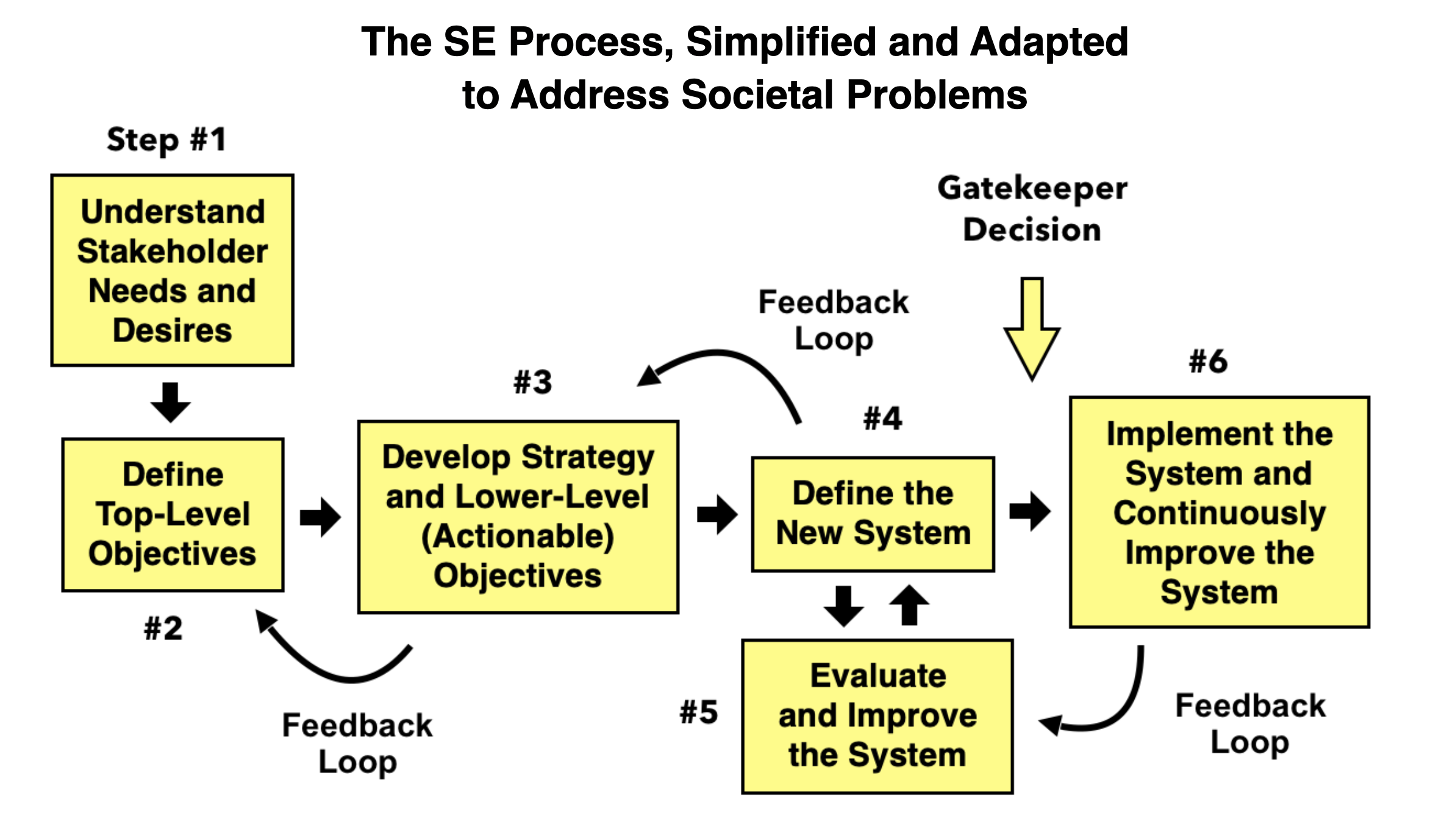
Step #3 requires creative thinking to develop a strategy that achieves the top-level objectives and key stakeholder needs and desires. This forces one to reject ideological strategies that focus on just one or two objectives and develop a balanced approach that all stakeholders can support.
Steps #4 and #5 use the strategy developed in step #3 to define the new or improved system. To optimize the system, it is evaluated against the objectives, key stakeholder needs and desires, and other potential solutions. This forces one to consider alternatives, address deficiencies, and improve the proposed solution. Often, this leads to changes in the strategy developed in step #3.
Step #6 is implemented only after a gatekeeper (such as Congress and the president) approves the solution. To provide a check and balance, the gatekeeper must be different from the group developing the solution. The first five steps of the systems engineering process are repeated (ideally, as rapidly as practical) until the gatekeeper approves implementation. After a solution is implemented, the entire six-step process is repeated periodically to continuously improve it, using lessons learned from experience and new facts and data as they become available.