
Optimization Strategies
Systems engineers use many strategies to develop, improve, and optimize designs. Ten of the most important engineering strategies are shown in the figure and discussed in the text following the figure. These strategies are equally useful when developing, improving, and optimizing public policies.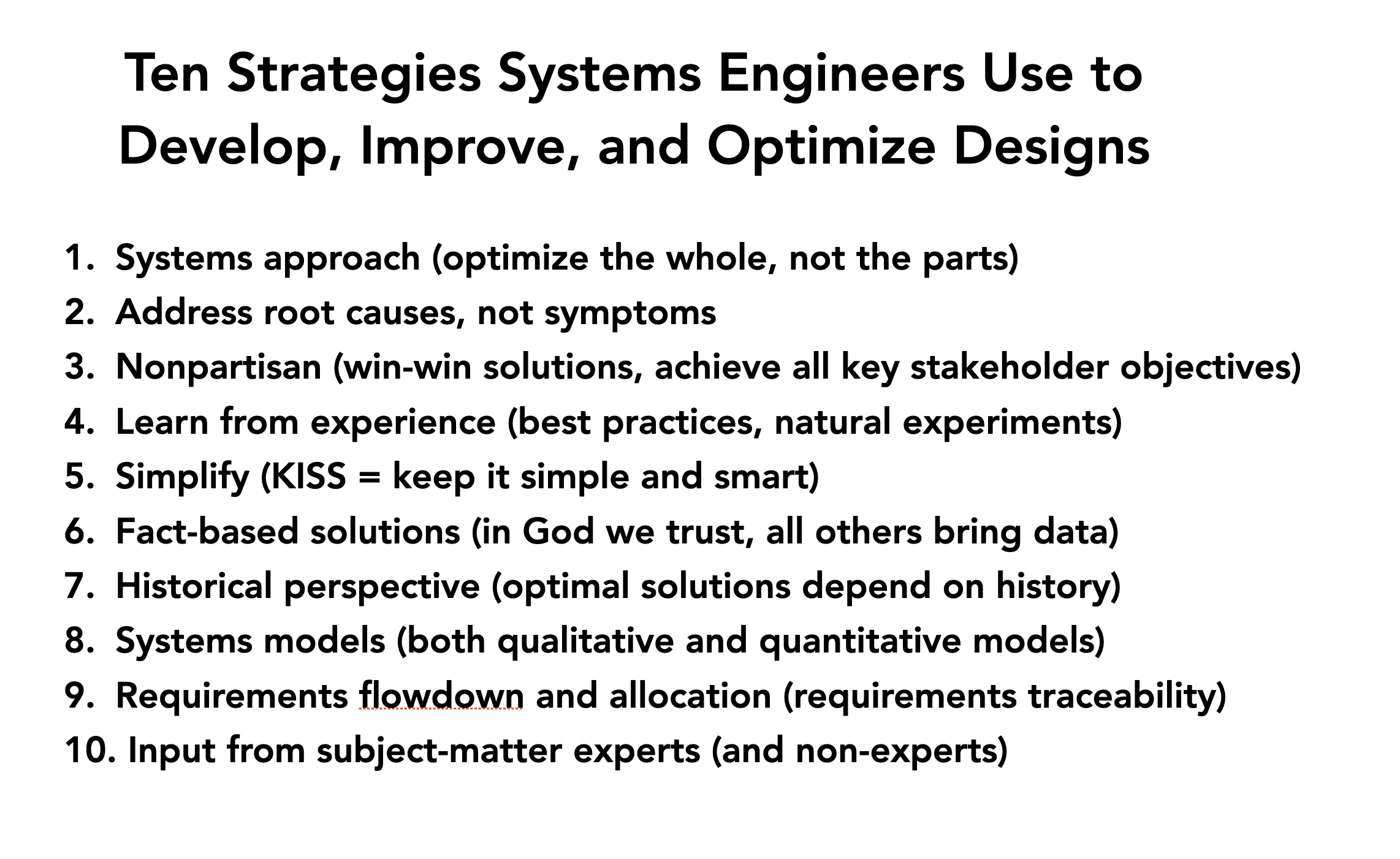
1. Systems approach. Systems engineers aim to optimize the entire system, not the components. For example, when designing an airplane, engineers optimize the entire airplane rather than separately optimizing the wings, fuselage, engines, and cockpit. Similarly, public policies should attempt to resolve not only the immediate problem, but to do it in a way that also addresses other complementary problems, rather than make them worse.
2. Root causes. Proposed solution(s) should address the root causes of a problem rather than the symptoms. This is usually the most cost-effective and durable solution to problems.
3. Nonpartisan. This is a political term, but it applies to system engineering as well. For example, when designing an airplane, systems engineers must find a solution that satisfies the key objectives of all stakeholders. Similarly, public policies should address the needs and key objectives of all stakeholders. It is often very difficult to develop win-win solutions, but it is important in both engineering and public policy decision-making.
4. Learn from Experience. Operating experience data is collected and analyzed so that designs can be continuously improved. Companies often purchase their competitors products and take them apart to learn how to improve designs. Similarly, policymakers should learn by analyzing the strengths and weaknesses of current policies and by studying "best practices" from around the world. This is particularly important in areas such as healthcare, immigration, criminal justice system, and taxation, where the U.S. can learn much from other countries.
5. Simplify. This is a cardinal rule of engineering, and it is equally important for public policy. The simplest solutions are often the best.
6. Fact-Based Solutions. When Orville Wright designed his first airplane, it was not successful because he used (erroneous) aerodynamic data collected by others. So he developed his own (valid) data and built an airplane that flew successfully. The lesson is clear: engineering designs and public policies must be based on valid data. Ideology is not a substitute for good data.
7. Historical Perspective. When developing a new design, engineers must be aware of the technologies and capabilities available to them, as developing new technologies and capabilities is often difficult and costly. Similarly, policymakers should take a historical perspective. For example, the "optimum" healthcare system in the U.S. is different from the optimum system in France because we have different histories and capabilities with respect to healthcare.
8. Systems Models. Systems engineers use a wide range of mathematical models to optimize designs. Public policies are not as easy to model mathematically, but quantitative and qualitative models are nevertheless important. For example, some policies such as climate policy should be informed by rigorous mathematical modeling. Other policies, such as good governance, are more difficult to model quantitatively, but qualitative system models can help policymakers understand the root causes of problems such as hyper-partisan politics, identify (undesirable) positive feedback mechanisms, and lead to more effective policies.
9. Requirements Flowdown and Allocation. Systems engineers rigorously define top-level requirements and flow down and allocate those requirements down to establish requirements for components. This is necessary to ensure that the components (when combined into the system) will achieve the top-level requirements. This is almost never done when developing public policies, but it should be. Even if the top-level requirements cannot be easily quantified, if they are written with precise language they can often be flowed down and allocated to create actionable (quantitative) lower-level objectives.
10. Subject Matter Experts. Last but not least, systems engineers rely on subject matter experts to inform their decisions. This does not mean that systems engineers blindly follow the advice of subject matter experts. Indeed, experts by their very nature often have a compartmentalized understanding of the issues. So systems engineers have to engage with experts to learn what they know and apply it in the most appropriate way to develop an optimum design solution. Policymakers should also use subject matter experts to inform their policies. Experts are often wrong with their proposed solutions, but the knowledge they possess is crucial to developing sound public policies.
Systems engineers use many strategies to develop, improve, and optimize designs. Ten of the most important engineering strategies are shown in the figure and discussed in the text following the figure. These strategies are equally useful when developing, improving, and optimizing public policies.
1. Systems approach. Systems engineers aim to optimize the entire system, not the components. For example, when designing an airplane, engineers optimize the entire airplane rather than separately optimizing the wings, fuselage, engines, and cockpit. Similarly, public policies should attempt to resolve not only the immediate problem, but to do it in a way that also addresses other complementary problems, rather than make them worse.
2. Root causes. Proposed solution(s) should address the root causes of a problem rather than the symptoms. This is usually the most cost-effective and durable solution to problems.
3. Nonpartisan. This is a political term, but it applies to system engineering as well. For example, when designing an airplane, systems engineers must find a solution that satisfies the key objectives of all stakeholders. Similarly, public policies should address the needs and key objectives of all stakeholders. It is often very difficult to develop win-win solutions, but it is important in both engineering and public policy decision-making.
4. Learn from Experience. Operating experience data is collected and analyzed so that designs can be continuously improved. Companies often purchase their competitors products and take them apart to learn how to improve designs. Similarly, policymakers should learn by analyzing the strengths and weaknesses of current policies and by studying "best practices" from around the world. This is particularly important in areas such as healthcare, immigration, criminal justice system, and taxation, where the U.S. can learn much from other countries.
5. Simplify. This is a cardinal rule of engineering, and it is equally important for public policy. The simplest solutions are often the best.
6. Fact-Based Solutions. When Orville Wright designed his first airplane, it was not successful because he used (erroneous) aerodynamic data collected by others. So he developed his own (valid) data and built an airplane that flew successfully. The lesson is clear: engineering designs and public policies must be based on valid data. Ideology is not a substitute for good data.
7. Historical Perspective. When developing a new design, engineers must be aware of the technologies and capabilities available to them, as developing new technologies and capabilities is often difficult and costly. Similarly, policymakers should take a historical perspective. For example, the "optimum" healthcare system in the U.S. is different from the optimum system in France because we have different histories and capabilities with respect to healthcare.
8. Systems Models. Systems engineers use a wide range of mathematical models to optimize designs. Public policies are not as easy to model mathematically, but quantitative and qualitative models are nevertheless important. For example, some policies such as climate policy should be informed by rigorous mathematical modeling. Other policies, such as good governance, are more difficult to model quantitatively, but qualitative system models can help policymakers understand the root causes of problems such as hyper-partisan politics, identify (undesirable) positive feedback mechanisms, and lead to more effective policies.
9. Requirements Flowdown and Allocation. Systems engineers rigorously define top-level requirements and flow down and allocate those requirements down to establish requirements for components. This is necessary to ensure that the components (when combined into the system) will achieve the top-level requirements. This is almost never done when developing public policies, but it should be. Even if the top-level requirements cannot be easily quantified, if they are written with precise language they can often be flowed down and allocated to create actionable (quantitative) lower-level objectives.
10. Subject Matter Experts. Last but not least, systems engineers rely on subject matter experts to inform their decisions. This does not mean that systems engineers blindly follow the advice of subject matter experts. Indeed, experts by their very nature often have a compartmentalized understanding of the issues. So systems engineers have to engage with experts to learn what they know and apply it in the most appropriate way to develop an optimum design solution. Policymakers should also use subject matter experts to inform their policies. Experts are often wrong with their proposed solutions, but the knowledge they possess is crucial to developing sound public policies.